
The Long War #58
A drone strike in Starobilsk, police and mobilisation, migrant workers & more

KYIV—A lot of people in Kyiv said that last weekend’s Russian attack on the capital had been the worst of the entire war, and they’re probably right. Going through a drone and missile attack is an intensely personal experience, one that is very slightly different for everyone. In my case, I’m still not sure whether to put this night above one of unrelenting drone strikes back in October, when I heard the screams of Shahed drones diving to their targets a couple of hundred meters from my flat. Still, explosions from ballistic missiles are loud and scary in a way even drones aren’t—more bassy, going deeper into the stomach. Last weekend wasn’t the first time an explosion burst open my kitchen’s window (it doesn’t close properly, so any explosion that will trigger the alarms of nearby cars will also usually break it open) but it was the first time one explosion —probably from the missile that hit the Chornobyl museum, a couple hundreds meters from my place—shook the entire building. So maybe it was worse, yes.
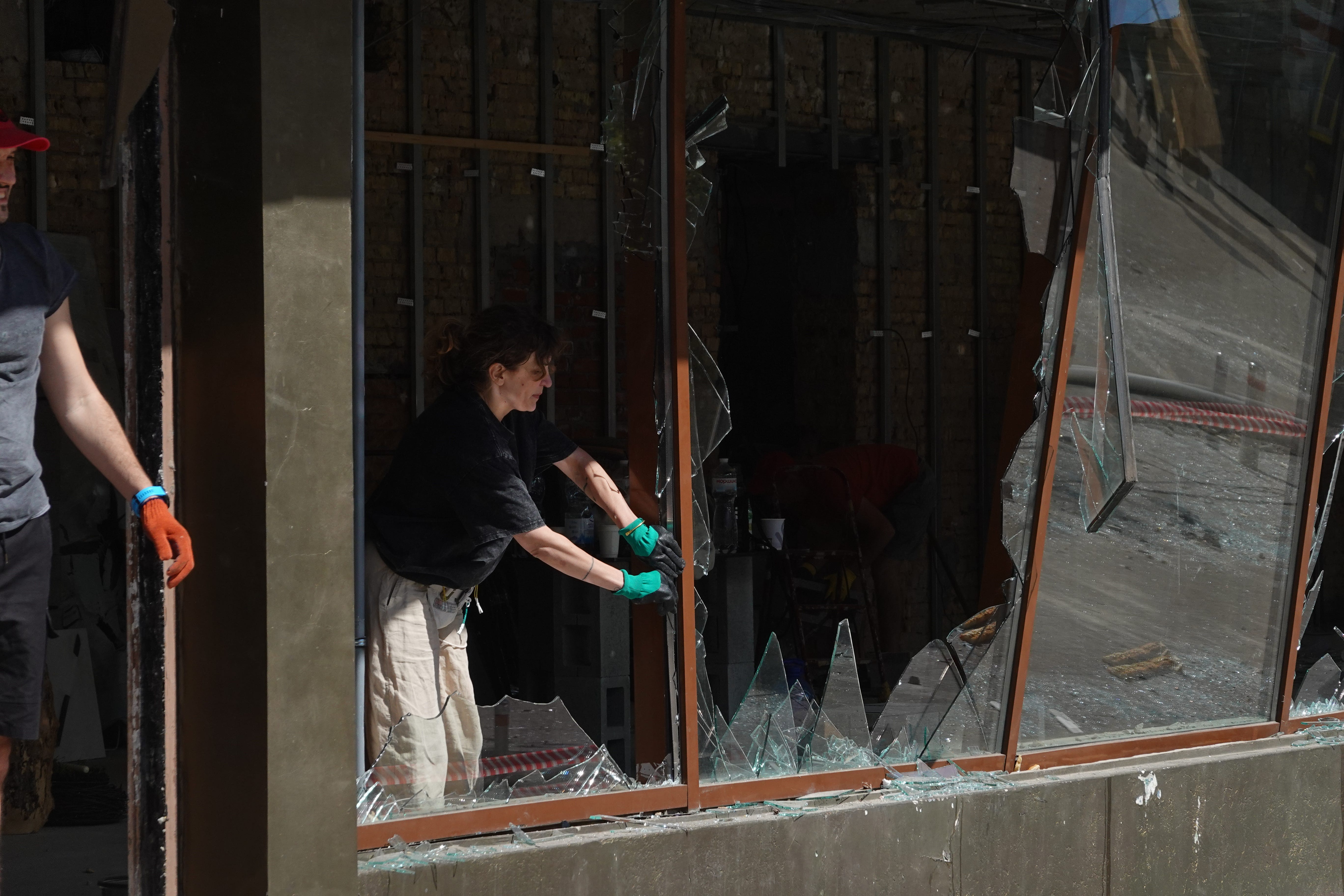
To begin this issue’s selection of interesting stories from across Ukraine, I first wanted to highlight and praise this piece by Realna Gazeta, a Ukrainian regional outlet exiled from Luhansk since 2014, which wrote this week about the Ukrainian drone strike on a college dormitory in the Russian-occupied town of Starobilsk, Luhansk region:
“There were students there. What’s up with the discussion about the strike in occupied Starobilsk?”
Russian authorities said at least 21 people, most of them students from a professional college, were killed in the attack. Ukraine’s General Staff said it hit a headquarters of the Russian ‘Rubicon’ drone unit and denied having hit “civilian infrastructure”. Multiple claims have been made by Ukrainian pundits or on social media that the students reportedly killed did not exist or, alternatively, that they were training to become drone pilots.
In such a tense atmosphere, it’s all the more commendable of Realna Gazeta to focus its story on what is known and dismiss what is clearly wrong: yes, “the dead are real people”, as proven by still accessible Vkontake pages; no, there’s no evidence that military units were stationed there or were hit in the strike (though Realna Gazeta points out of that several parts of the university were blocked to journalists present and local authorities are clamping down hard on the publication of footage showing attacks); no, a document claiming that a Russian brigade was using the dormitory almost certainly isn’t authentic; yes, Russian propaganda is exploiting the tragedy to the fullest, bringing foreign journalists on location in order to craft the narrative; no, there’s no evidence that the students were being trained as drone operators.
“People who now live in the occupied territories are not collaborators by default,” journalist Elena Fetisova writes. “They found themselves under occupation against their will. Girls who grew up in occupied Luhansk studied from Russian textbooks, lived in a media environment devoid of Ukrainian television, and attended schools that the occupiers had reshaped to suit their own purposes. It is strange to demand vivid displays of Ukrainian identity from them. The willingness to deny human dignity to residents of the occupied territories is not patriotism. It is a reproduction of the very logic against which Ukraine is fighting.”
The war continues and expands, in the rear and at the front. The second piece I wanted to bring to your attention looks at the depressingly familiar scenes playing out near the Donbas stronghold of Kramatorsk and Sloviansk:
“How will people in Mykolaivka evacuate if the enemy takes control of all the roads?”
The anxiety and exhausting routine of the war for civilians is summed up in this story by Karachun, a local outlet from the city of Sloviansk. With powerless frustration, journalist Oleksandr Kulbaka writes that the situation unfolding in villages on the outskirts of Sloviansk looks like a “carbon copy” of what has happened so many times before: people staying home until the last moment, when leaving means risking their lives: “then they are forced to leave on foot, walk through fields. And then they regret that they did not agree to go on an evacuation bus when they had the opportunity.” This mix of delusional hope, denial of reality and deep fear of the future (“where am I supposed to go?”, people ask again and again) seem to even extend to the local administration: in Mykolaivka, a village currently ten kilometers from the frontline, municipal workers were, in late April, still “covering broken window and door blocks with tarpaulins, and distributed building materials to residents of apartments affected by shelling”. The story ends with a video of an evacuation from that same village, along a desolate road lined with charred vehicles.
Returning to Ukraine’s rear, the enduring question of how to sustain the war effort and keep mobilizing troops in the face of growing resistance is more acute than ever, despite the more upbeat mood in official circles. One story published last month by Ukrainian outlet Babel provides an interesting insight into this discussion:
‘Policemen are invited to the funerals of the guys they mobilized.’ An interview with the head of the patrol police, Oleksandr Fatsevych, about the shooting in Holosiiv and the system’s problems
The interview came after a man shot six people dead in Kyiv last month. The shooting as well as the police’s alleged failures during the crisis immediately triggered a broader conversation—about Ukrainians’ right to carry weapons (they are very limited, even in peacetime) and about the work of the police during the invasion.
The explanation of the various ways the war has made the work of the police different is more challenging is really what makes this interview so interesting. In a situation where police units are operating on the frontline, Oleksandr Fatsevych has to point out that “the use of weapons by combat units and the use of weapons by police are very different”.
His main focus remains the shortage of personnel, with Fatsevych saying that the patrol police (a specific part of the much bigger Ukrainian police) should have around 20,000 police officers across the country, effectively has 15-16,000, more than 2,000 of which are serving on the front. 3,000 more are “supporting the defense forces”, leaving the cities where they are supposed to work to take positions in quiet border areas, in order to free up military manpower for hotter parts of the frontline. Other war-related tasks stretching the patrol police even thinner include manning checkpoints, escorting sensitive cargo… and working with the military recruiters tasked with enforcing mobilization across the country.
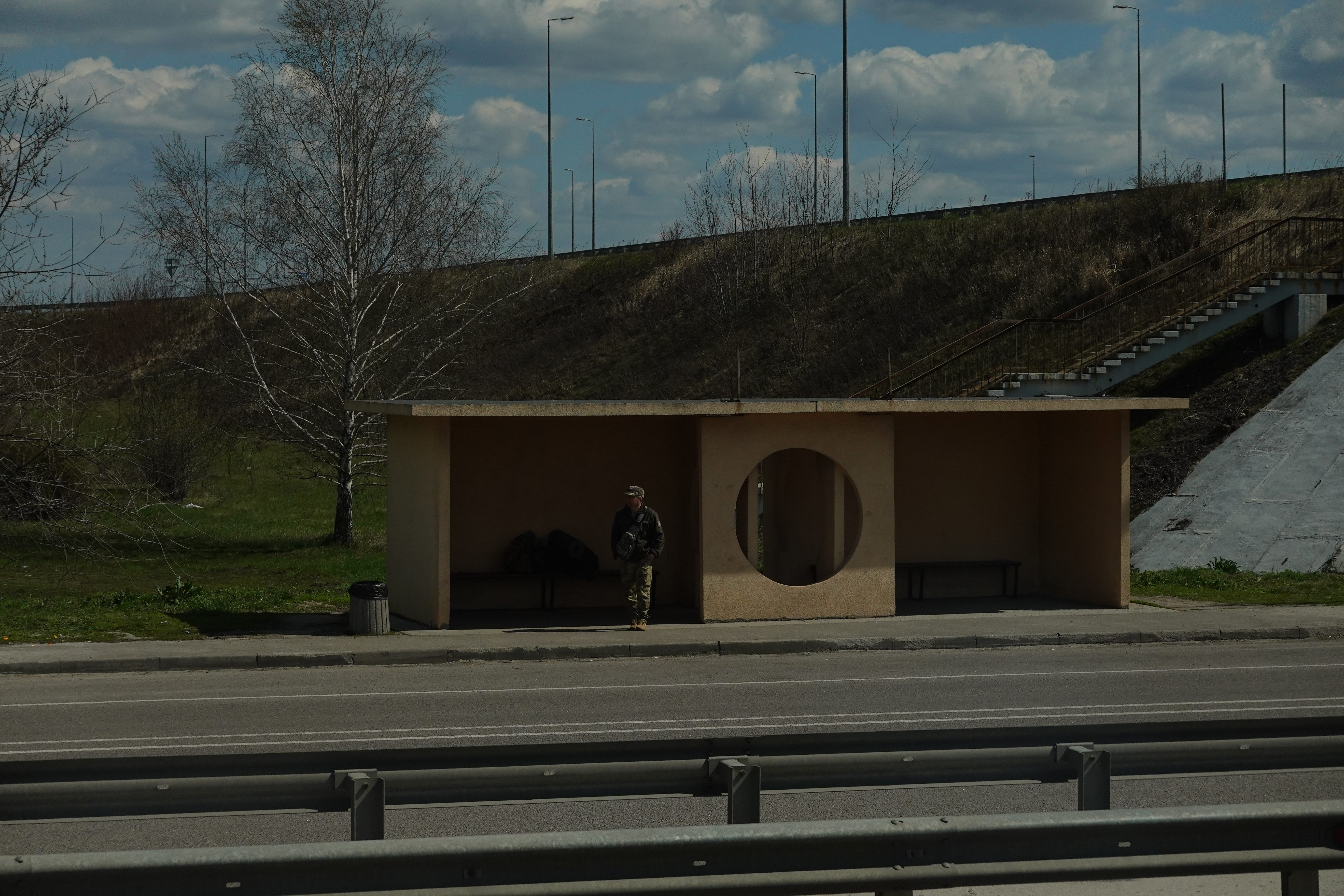
That last job “is reducing trust in the police to zero,” Fatsevych says. Behind the remark is a major issue and the source of a bitter institutional struggle, as newly-appointed Defense minister Mykhailo Fedorov seeks to overhaul the mobilization system. One idea has been to give the police the unenviable task of hauling would-be draftees to the training centers, which would put the police center stage in the mobilization process (rather than the supporting role they have now).
But the massive unpopularity of mobilization in general and of the officers in recruitment centers responsible for the ‘busification’ in particular means that the police is unsurprisingly reluctant to take on this additional burden. In this interview, Fatsevych claims that the work police officers currently do as part of the mobilisation process (they usually shadow recruitment officers and perform checks) is already the cause of a personnel outflow: “Why do police officers and patrol officers resign? We analyzed it. Most resign because they don’t want to be involved in mobilization. We have police officers invited to funerals—to the funerals of the guys they mobilized. The head of the district police station, the community police officer and the patrol officer are hated there. They can’t stand it and resign. Some accept their call-up papers and go off to fight.”
Another, entirely different topic has also grabbed headlines in Ukraine this past month:
“‘More Indians with suitcases.’ Why Ukrainians fear migrant workers, who is fueling the panic, and what the numbers say”
Fear of migrant workers from India or Pakistan flooding the country has been making a surprising amount of waves on Ukrainian social media these past weeks, with outlet Hromadske attempting in this piece to take stock of the situation.
The ‘debate’ has featured a wave of AI-fueled xenophobia, tens of thousands of posts on social media (many of which showed fake pictures of Indians posing in front of Ukrainian street signs) and even protests organized in several cities last weekend (the one in Kyiv only gathered about a hundred people).
Making the outrage all the more peculiar is the fact that, as of right now, it seems to rests on essentially nothing: Hromadske says just shy of 5,000 work permits were given out to foreigners in Ukraine last year, a tiny number that stands in sharp contrast with some message about Ukraine being overwhelmed with Indians. There have been claims that the whole thing is the result of Russian bots pushing the message on social media—while there’s no strong evidence of this yet, it sure doesn’t seem implausible, given how suddenly and for seemingly no reason this topic gathered steam on social networks.
But it’s also clear that this controversy is rooted in the very real anxieties of a broadly conservative society looking with anguish at the demographic cataclysm that Ukraine is facing. The question of whether Ukraine’s demographic deficit should be plugged with migrant workers is really the question of what the country that Ukrainians are fighting for should look like.
The last thing I’d like to discuss in this newsletter is something I’ve brought up before. Twice in this newsletter I wrote about Ukrainian regional outlet Poltavshyna and how, every week since May 2022, it had been publishing a story listing the names and short biographies of soldiers from the Poltava region whose death had been officially reported in the previous seven days. Poltavshyna’s grim count was first mentioned here in June 2023, when I highlighted the Reuters story that brought this initiative to my attention, and then again in January 2024.
A story I’ve been working on has led me to think about death on the battlefield more often than usual, and I wondered a few days ago whether, four years into the invasion, Poltavshyna still ran this count. It does, with the latest story dated May 25 noting that the death of 30 local soldiers had been reported in the last week—the youngest 25 years-old, the oldest 63.
Can this unrelenting and very partial count tell us anything about the war, four years years after Poltavshyna began this work? Could this focus on one region, and therefore one small number of units, highlight the war’s ebb and flow and its transformation? I put together this graph showing the number of Ukrainian soldiers from the Poltava region killed every month since January 2023, according to Poltavshyna’s reporting:
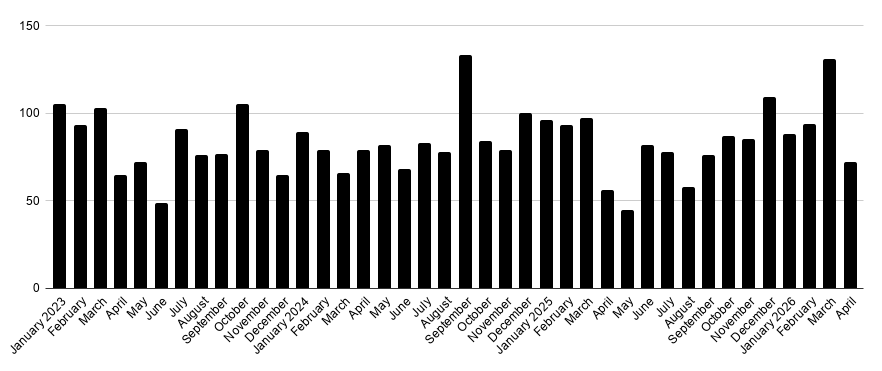
Most striking about this graph is how flat it is. You may discern a few changes, a dip in June 2023 and April/May 2025, the first months of 2023 and of 2025 being particularly deadly, and there’s an apparent upward trend since the end of last year. But it’s not much, and I wouldn’t draw any conclusions from those numbers alone.
No, overall, you can’t really see anything on this graph. Not the fateful 2023 Ukrainian counter-offensive, not the evolving technological war and drone supremacy that has come to define the conflict. The only thing you can see is about 20 soldiers — sometimes closer to 15, sometimes to 30 — dying every week, week after week, for the past 172 weeks.